How Many Words Is a 5-Minute Speech? Full Table (1-30 Minutes)
You have a five-minute slot and a blank page. Write too much and you will be rushed off the stage mid-sentence. Write too little and you will stand there with two minutes of silence. This guide gives you the exact word count for a 5-minute speech, the full table from 1 to 30 minutes, and the one rehearsal trick that makes the number real.
Quick answer
A 5-minute speech is about 650 words at a normal speaking pace of 130 words per minute. Slow, deliberate speakers land near 500 words; fast, energetic ones near 750. The only number that truly matters is yours: paste your script into a word counter, read it aloud once with a timer running, and adjust. The full 1-to-30-minute table is below.
The full speech-length table: 1 to 30 minutes
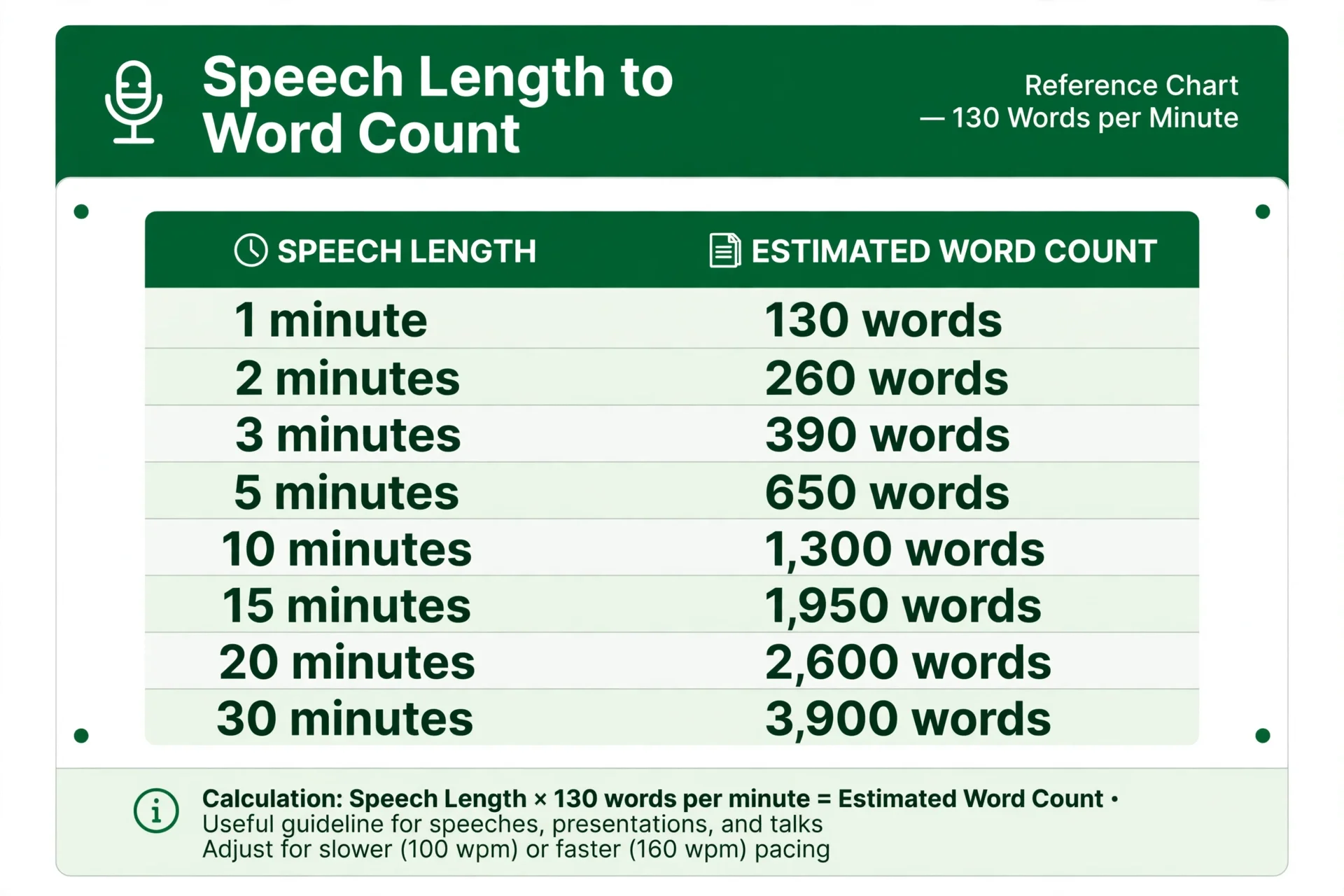
Bookmark this. The formula behind every row is simple: minutes times words per minute. The middle column uses 130 words per minute, the safe planning pace for a prepared speech. The outer columns show the range you get if you speak slowly or quickly.
| Speech length | Slow pace (110 wpm) | Planning pace (130 wpm) | Fast pace (150 wpm) |
|---|---|---|---|
| 1 minute | 110 words | 130 words | 150 words |
| 2 minutes | 220 words | 260 words | 300 words |
| 3 minutes | 330 words | 390 words | 450 words |
| 4 minutes | 440 words | 520 words | 600 words |
| 5 minutes | 550 words | 650 words | 750 words |
| 7 minutes | 770 words | 910 words | 1,050 words |
| 10 minutes | 1,100 words | 1,300 words | 1,500 words |
| 15 minutes | 1,650 words | 1,950 words | 2,250 words |
| 20 minutes | 2,200 words | 2,600 words | 3,000 words |
| 25 minutes | 2,750 words | 3,250 words | 3,750 words |
| 30 minutes | 3,300 words | 3,900 words | 4,500 words |
Read the table as a range, not a promise. If your 5-minute draft sits between 600 and 700 words, you are in the safe zone. If it is pushing 800, start cutting now, because the next section explains why the number on the page is almost always shorter than the number in the room.
Why 130 words per minute is the planning number
Ask three speech coaches how fast people talk and you will get a range, not a number. Adobe's presentation guide puts most speakers between 100 and 150 words per minute and calls 125 a good steady benchmark. Orai, the public-speaking coach app, uses 125 to 150 for clear presentations. Word-counter sites that publish speech tables mostly settle on 130 to 150.
So why plan at 130 and not 150? Because real rooms slow you down. VirtualSpeech measured 32,809 practice presentations in 2026 and found the median speaker ran at just 111 words per minute, with the middle half between 86 and 133. The highest-rated presenters sat at 138. In other words, almost everyone speaks slower on stage than the benchmarks suggest, and the people who score best land almost exactly on the planning number.
The gap comes from everything a word count cannot see. You pause after the opening line. You wait for the laugh. You slow down to land a number or a name. You breathe. A script read silently in your head feels fast. The same script spoken to forty faces runs 10 to 20 percent longer. Planning at 130 builds that reality into the math before you ever stand up.
One more distinction worth knowing: conversational speech is faster. Everyday talking runs 140 to 180 words per minute, and audiobook narrators hold 150 to 160. A speech is neither. It is paced for an audience hearing your ideas once, with no rewind button. If someone tells you "I talk fast, I will use 160," smile and plan at 140. The microphone has humbled faster talkers.
How many words is a 3-minute speech? A 10-minute speech?
The table above covers both, but these two lengths deserve their own notes because they are where most people misjudge.
How many words is a 3-minute speech?
About 390 words at the planning pace. Three minutes sounds short until you try to fill it. It is roughly one typed page, enough for one clear point, a short story that proves it, and a closing line. The danger here is padding. When a 3-minute draft feels thin, speakers add throat-clearing instead of substance. Cut the throat-clearing and let the point breathe.
How many words is a 10-minute speech?
About 1,300 words at the planning pace. Ten minutes is the classic conference slot, and it is long enough that structure matters more than word count. Plan three beats: the problem, the story or evidence, and the takeaway. If your draft is 1,500 words, you are not 200 words over. You are one whole beat over, because you will slow down in the middle and the pauses will eat the margin.
What about a 2-minute or 7-minute speech?
Two minutes is 260 words: one idea, stated well. Seven minutes is 910 words: the same three-beat structure as ten minutes, tightened. Odd lengths usually come from event programs, so ask the organizer whether the slot includes introductions and applause. A "7-minute slot" with a 1-minute intro is a 6-minute speech.
Measure your own speaking pace in 3 minutes
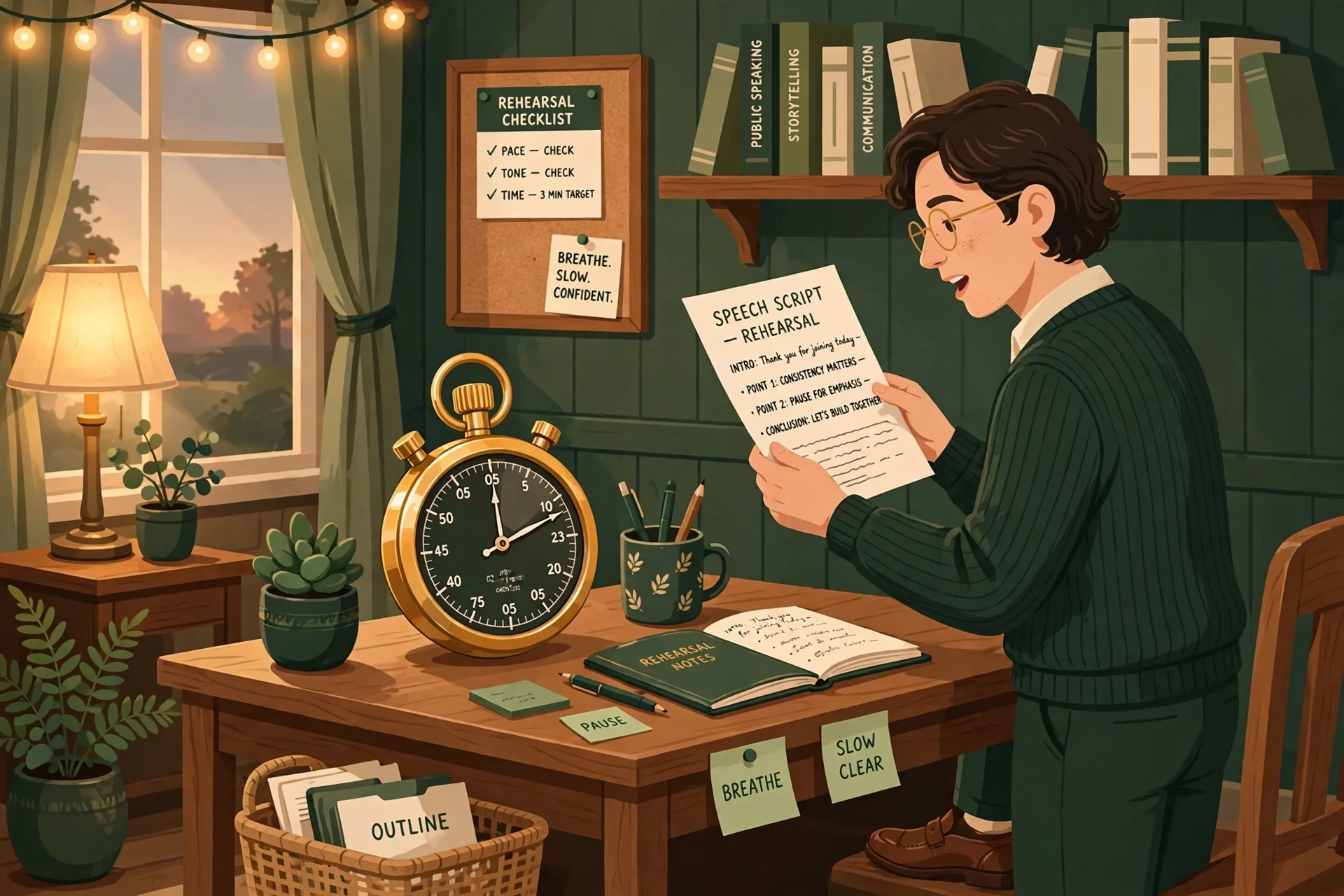
Charts estimate. Rehearsal measures. This takes three minutes and gives you a personal number no table can.
- Count your draft's words. Paste your script into the free Word Counter. Note the word count and the speaking-time figure, which is worked out at roughly 130 words per minute. That figure is your baseline, not your answer.
- Stand up and read it aloud. Hold the pages or your phone the way you will on the day. Start a timer, read the whole script at your natural pace, and do not stop for stumbles. Stumbles happen in the room too.
- Do the division. Divide your word count by the minutes it took. A 650-word script that took 5 minutes 30 seconds means you speak at about 118 words per minute. That is your real pace.
- Plan with your number. Multiply your slot length by your pace. A 10-minute slot at 118 words per minute means a 1,180-word script, not the 1,300 the chart suggests. The chart got you close. Your voice gets you exact.
Do this once and you will never need the table again for your own speaking. Everyone's pace is a little different, and after one timed read-through you own a personal benchmark that beats any general average.
When the 650-word number lies
The chart assumes a neutral talk to a neutral audience. Some occasions are not neutral. Adjust the pace before you trust the math.
| Occasion | Realistic pace | 5-minute script |
|---|---|---|
| Eulogy or memorial | 100-120 wpm | 500-600 words |
| Wedding toast, best man or maid of honor | 120-130 wpm | 600-650 words |
| Class presentation | 120-140 wpm | 600-700 words |
| Conference keynote | 130-150 wpm | 650-750 words |
| Technical briefing | 110-125 wpm | 550-625 words |
| Speaking in a second language | 100-120 wpm | 500-600 words |
A eulogy runs slow because grief needs pauses and the room needs them too. A wedding toast looks short on paper, then the laughter and the glass-raising eat a full minute. Technical material forces you to slow down for terms and numbers the audience must catch the first time. And if English is not your first language, plan at the slow end and rehearse twice. The audience will remember a calm, clear delivery far longer than a complete script.
The honest rule: pick the pace that matches the hardest part of your talk, not the easiest. Your opening story might fly at 150 words per minute, but the data section will crawl at 110. Plan for the crawl.
How to cut a script that runs too long
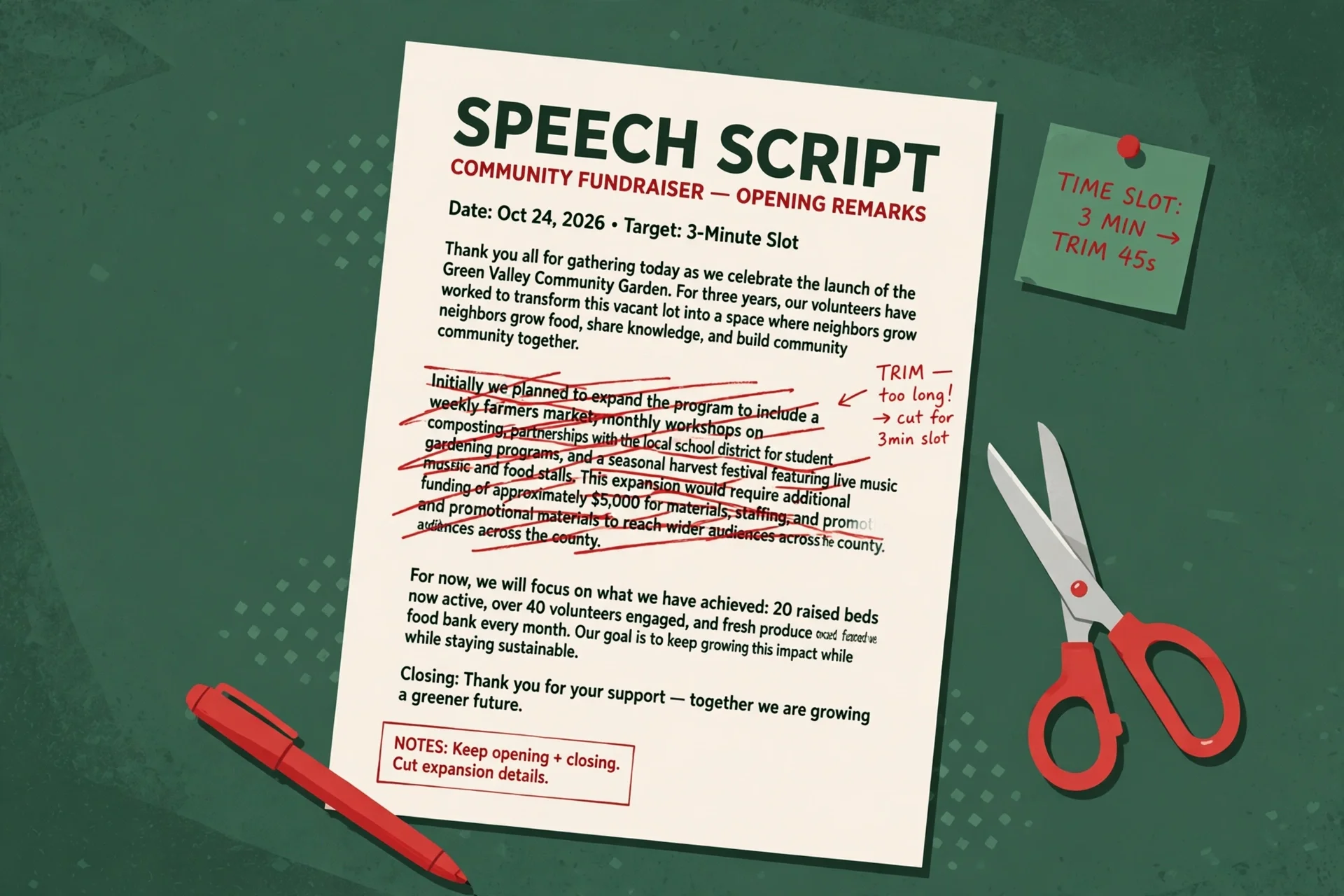
Your read-through came in at 6 minutes 20 seconds for a 5-minute slot. You need to lose about 170 words. Here is how to do it without gutting the speech.
Cut whole paragraphs, not words. Trimming "very" and "really" from every sentence saves almost nothing and makes the writing worse. Find one full beat the speech can live without, usually the second example proving a point the first example already proved, and remove it entirely. One story told fully beats two told in a hurry.
Protect the opening and the ending. Audiences remember the first line and the last line. Everything in the middle is negotiable. Mark your opening and closing as untouchable before you start cutting, then be ruthless with the middle.
Turn sentences into pauses. A two-second pause after a key line costs you 4 or 5 words of time and buys you more attention than the sentence you deleted. Speakers who fear silence fill it with words. Confident speakers spend it.
If you are short, add a story, not adjectives. Padding a thin script with longer words sounds padded. One concrete 60-word story adds a minute of warmth and a minute of time. The audience will never know it was filler.
After every round of cuts, read it aloud again. Cutting changes rhythm, and rhythm changes pace. The second read-through is the one you trust.
Common mistakes and fixes
- Writing to the maximum. A 750-word draft at a fast pace leaves zero room for pauses, laughter, or nerves. Aim for 600 to 650 words and let the room give you the rest. Nobody has ever complained that a speech ended a minute early.
- Timing a silent read. Reading in your head is 20 to 30 percent faster than speaking to a room. If you timed it silently, add a quarter to the result or, better, stand up and do it properly.
- Forgetting everything around the words. Introductions, applause, slide changes, and Q&A all eat the slot. Ask what the "5 minutes" includes, then add a 10 to 15 percent buffer for a live talk.
- Rehearsing sitting down. Sitting at a desk and skimming gives a number that is always short. Stand, hold the pages or phone as you will on the day, and read the whole thing. That is the number you plan with.
- Counting on adrenaline to speed you up. Nerves make most people faster and thinner-voiced, which feels like running short, so they cram in more words. Then the pauses they skipped on stage never happen and they finish early and rattled. Plan at your rehearsed pace, not your nervous fantasy pace.
Frequently asked questions
How many words is a 5-minute speech at a normal pace?
About 650 words at 130 words per minute, which is the standard planning pace for a prepared speech. Most speakers land between 600 and 750 words depending on how fast they talk. Write toward 650, then confirm with one timed read-aloud.
How many words is a 10-minute speech?
About 1,300 words at the 130-words-per-minute planning pace. Slow speakers should plan closer to 1,100 words and fast speakers up to 1,500. For a 10-minute slot, structure matters as much as count: open with the problem, support it with evidence, and close with the takeaway.
How many words is a 3-minute speech?
About 390 words at a normal pace. That is roughly one typed page: one clear point, a short supporting story, and a closing line. Keep it tight, because padding a 3-minute script is the fastest way to lose the room.
How fast should I speak during a presentation?
Aim for 120 to 150 words per minute, with 130 as the planning benchmark. Adobe's presentation guide suggests 125 as a steady pace, and 2026 data from VirtualSpeech found the highest-rated presenters at 138. Below 100 sounds hesitant; above 160 hurts comprehension.
Is 1,000 words too long for a 5-minute speech?
Yes. At 130 words per minute, 1,000 words takes nearly 8 minutes to deliver, and even a fast 160-word-per-minute pace needs over 6 minutes. For a 5-minute slot, cut the script to about 650 words instead of trying to talk faster.
How can I tell if my speech fits the time?
Paste the script into a word counter to get the exact count and a speaking-time estimate, then read the whole script aloud while standing, with a timer running. Divide words by minutes for your personal pace. That single rehearsal is more reliable than any chart.
Check your script's speaking time free
Stop guessing from a chart. Paste your draft into the free Word Counter and look at the speaking-time figure next to the word count. It is worked out at roughly 130 words per minute, so a 650-word script shows about 5 minutes. Trim or pad the draft until the figure matches your slot, then do the one read-aloud rehearsal to lock it in.
How we tested this: we read the Word Counter's code on this site and confirmed the speaking-time figure divides your word count by roughly 130 words per minute, and that pasted text is processed entirely in the browser with no network requests, so your draft never leaves your device. Before a real slot, read the script aloud once with a timer. That read-through is the only test that counts.
Privacy note: the Word Counter works on text you paste into the page. We checked: it makes no network requests while counting, so nothing is uploaded, stored, or logged. Your unfinished speech stays yours.
Last updated: October 24, 2026
Related tools and guides
Count Words in a PDF: 3 Free Ways That Actually Work
Script saved as a PDF? Count its words three ways.
Read article →How Many Pages Is 1,000 Words? Charts for Essays & Docs
Turn your script's word count into printed pages.
Read article →How to Count Words Online Free - Fast Word Counter
The full guide to counting words, characters, and reading time.
Read article →