How Many Words Is a 10-Minute Presentation? Full Timing Table
You have ten minutes on stage and a script that feels right on paper. The question is whether it fits the clock. At a normal speaking pace, a 10-minute presentation needs about 1,300 to 1,500 words, and your own pace decides where inside that range you land.
Quick answer
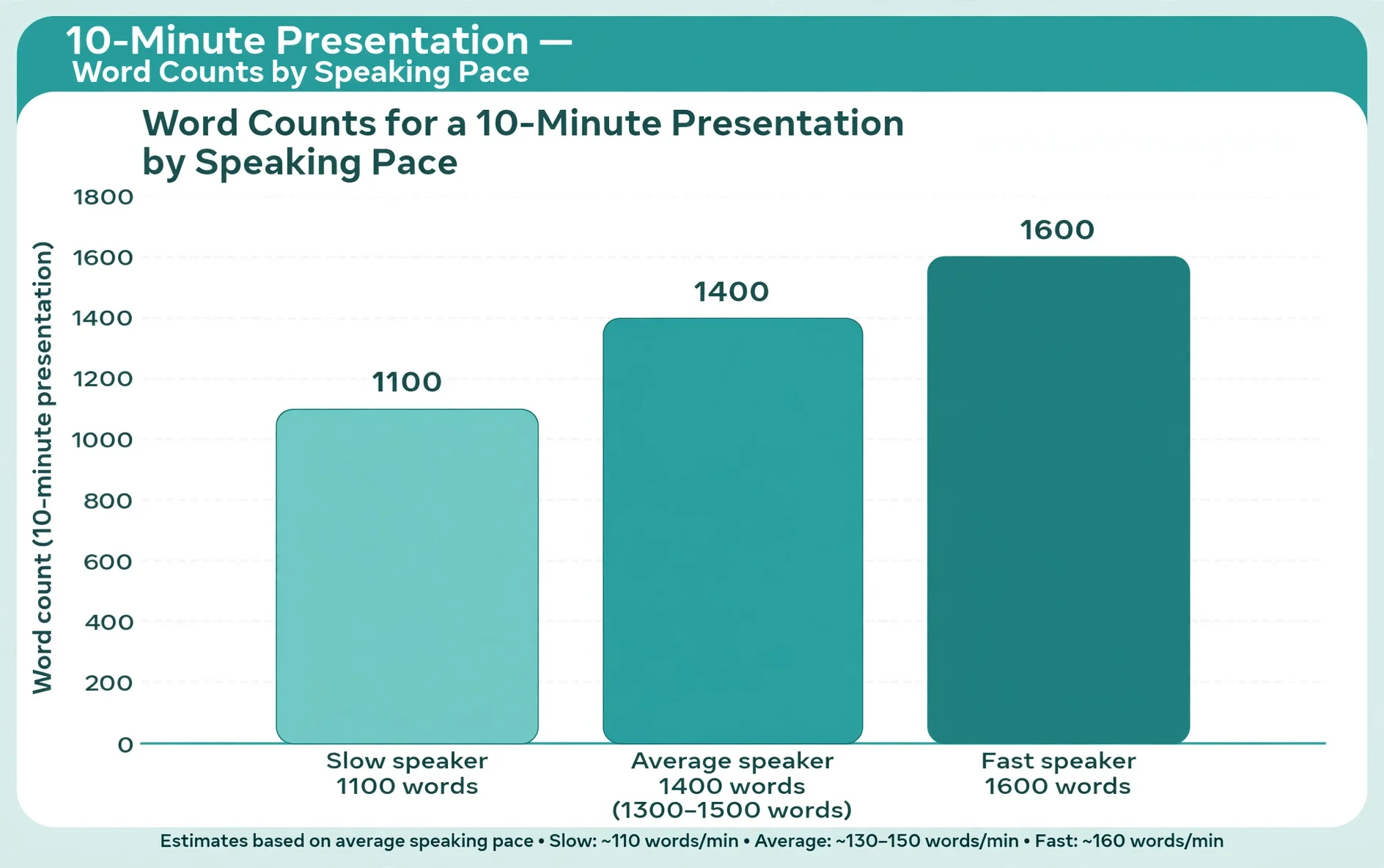
A 10-minute presentation is about 1,300 to 1,500 words at a normal speaking pace of 130 to 150 words per minute. Slow, deliberate speakers fill 10 minutes with about 1,100 words, and fast speakers can reach about 1,600. If you have never timed yourself, plan for 1,300 words, leave room for pauses and slides, and test the script out loud before the day.
Timing table by pace
The whole calculation rests on one number: words per minute. Multiply your pace by your minutes, and you have your word target. The table below shows the result for a 10-minute slot at four common paces, so you can pick the column that sounds like you.
| Pace | Words per minute | 10 minutes |
|---|---|---|
| Slow, deliberate | 110 | About 1,100 words |
| Average presentation | 130 | About 1,300 words |
| Confident, steady | 150 | About 1,500 words |
| Fast, energetic | 160 | About 1,600 words |
Most speakers land between 130 and 150 words per minute when they present, which is why the headline range is 1,300 to 1,500 words. Adobe Express gives a similar picture: most speakers average 100 to 150 words per minute, with 125 words per minute as a good benchmark for a steady pace, and a 10-minute talk at 125 to 150 words per minute needs roughly 1,300 to 1,600 words. The small differences between guides come from different speaker samples, not from different math, so treat every figure here as a planning estimate, not a measurement of you.
Your pace on the day will differ from your pace in rehearsal. Nerves speed some people up and slow others down. A room that laughs, asks questions, or waits for a demo eats minutes that a bedroom rehearsal never spends. That is why experienced speakers aim for 90 to 95 percent of the table figure, leaving a cushion for the room itself.
What slows you down
Three things bend the count down from the table, and all three are normal parts of a good talk.
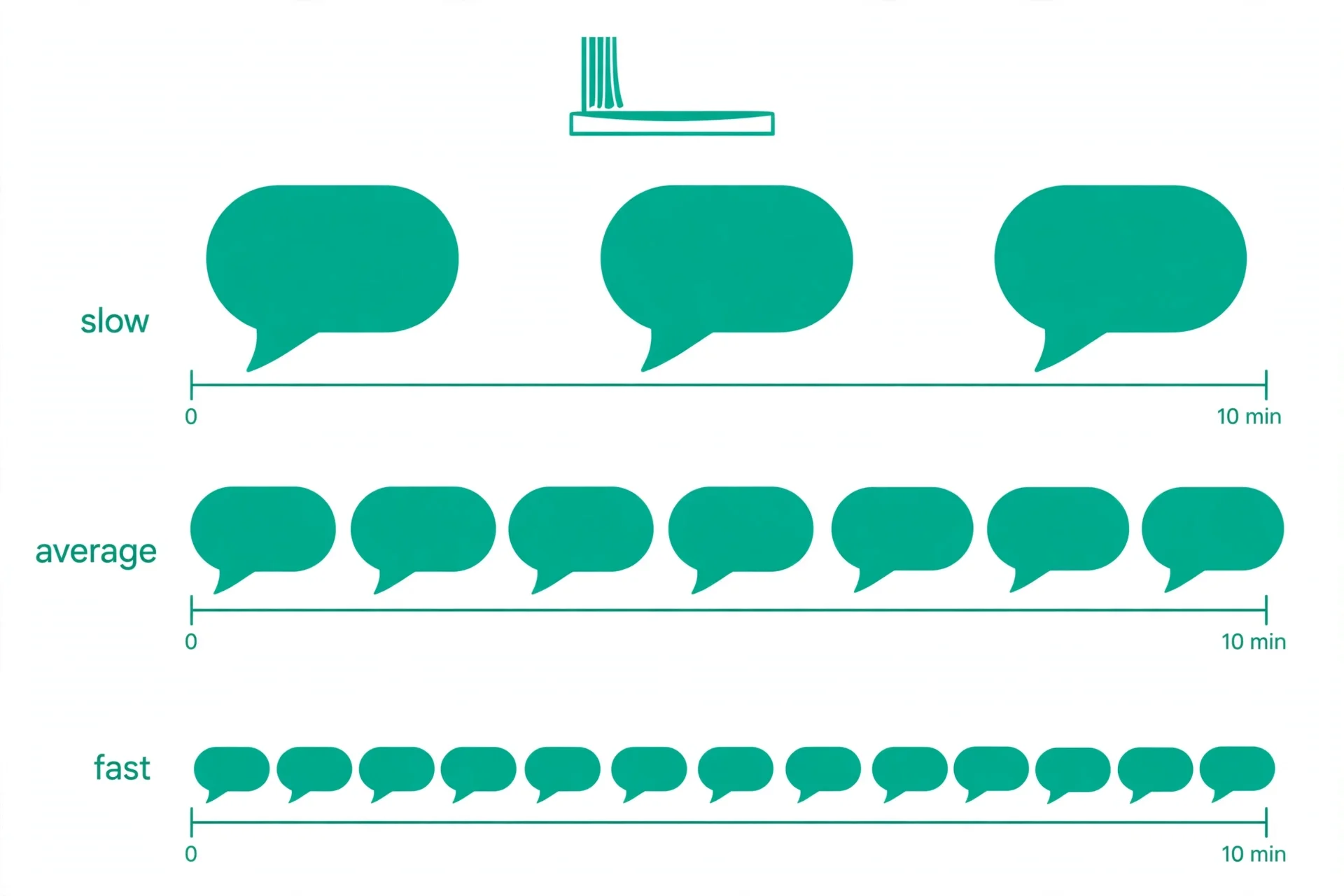
Pauses. A beat of silence after a key line is worth more than another sentence, but it spends time. Pauses for emphasis, pauses while the audience reads a slide, and pauses to breathe all add up. A script timed with zero pauses will overrun on stage, because a live talk without pauses is hard to follow.
Slides, demos, and video. Every slide change costs a few seconds while the audience finds the new slide. A live demo costs minutes, and a 60-second video clip costs a full minute of speaking time, which means about 130 to 150 fewer script words. Budget demo and video time first, then write the script for the minutes that remain.
Hard content. Numbers, names, dates, and technical terms take longer to say cleanly than plain words. A script full of figures and jargon runs slower than the same word count in plain language. If your talk is technical, use the slow column of the table, even if you normally speak fast.
Slides and script together
A common rule of thumb is about one slide per minute, which puts a 10-minute talk near 10 slides, with a practical range of about 8 to 12 depending on content. A title slide and a closing slide sit outside the speaking flow, so a deck of 12 slides often means about 10 content slides.
Slides and script compete for the same minutes. A slide crowded with text forces the audience to read while you talk, and reading slows everyone down. Keep slides to one idea each, with a few short lines or a single image, and let your voice carry the detail. If a slide needs a paragraph of text, that paragraph is probably a handout, not a slide.
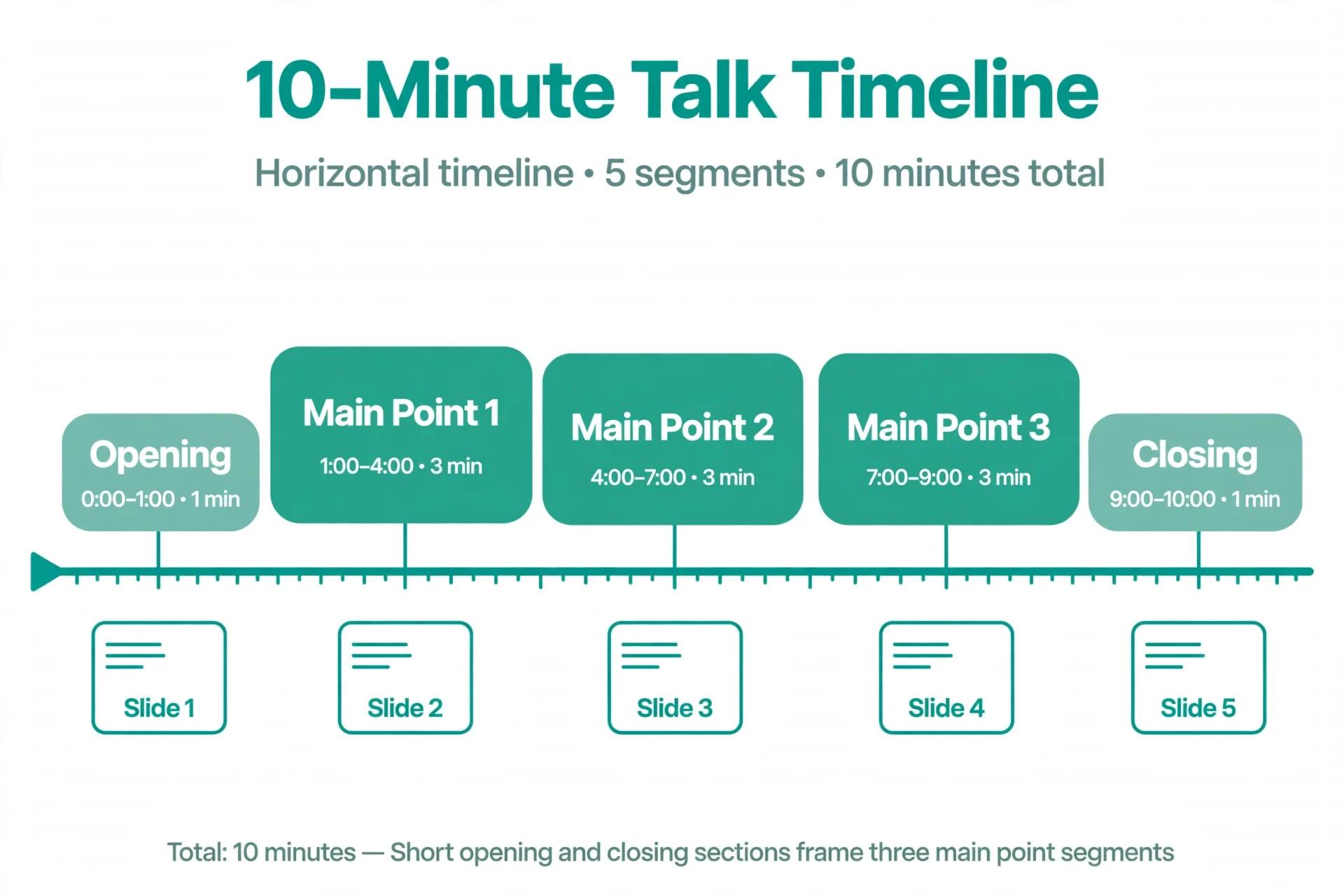
Plan the talk in blocks, not in slides. An opening of about 1 minute, three main points of about 2 to 3 minutes each, and a closing of about 1 minute fills 10 minutes with room to breathe. Write each block to its own word budget: roughly 130 to 150 words per minute of block time. When one block overruns in practice, you know exactly where to cut.
Trim or expand your script
Most first drafts miss the target in one direction. Fix it with structure, not by speaking faster or slower on the day.
Too long. Cut one example per point before you cut words across the board. A talk with three examples per point survives fine with two, and the cut saves a full minute. Next, cut throat-clearing: background the audience does not need, apologies for the topic, and repeated summaries. Read the script out loud and mark every sentence you stumble on. Stumbles usually mark sentences that should be shorter or gone.
Too short. Add a story, a worked example, or a pause for the audience to look at a slide. Stories add minutes without adding density, and they are the parts audiences remember. Avoid padding with filler phrases or restating the same point in new words. A second example beats a longer sentence every time.
Right length, wrong shape. If the opening runs long, the ending gets rushed, and the talk feels unbalanced even when the total fits. Time each block separately during practice. Move a minute from the longest block to the shortest, and the whole talk feels calmer without changing the total.
Practice routine that works
One timed read-aloud beats ten silent re-reads. Silent reading runs much faster than speaking, so a script that reads in 6 minutes can easily take 10 minutes on stage.
- Time the full script out loud, standing up. Use a phone timer. Note the total, and note where each block ends.
- Practice with the slides. Click through the deck as you speak, including the pauses while the audience reads each slide. The second run is always closer to the real time than the first.
- Cut to 90 to 95 percent. If the talk must fit 10 minutes, aim for a rehearsal time of about 9 to 9 and a half minutes. The cushion covers nerves, laughter, questions, and a slow start.
- Do one final run the day before. Sleep changes pacing, and a cold run the next morning tells you whether the timing held.
If you cannot rehearse out loud, use the table and pick the slow column. It is the safer error: a talk that ends 30 seconds early feels polished, while a talk cut off mid-sentence feels unfinished.
Common mistakes and fixes
Writing 2,000 words for 10 minutes. That is a 13 to 15 minute talk at normal pace. Cut about 500 to 700 words, or ask for a longer slot. Speaking faster to squeeze it in makes the talk hard to follow.
Reading the slides. Slide text plus spoken script double-counts the same words, and the audience reads faster than you speak. Put short cues on slides and full sentences in your mouth only.
Forgetting question time. If the slot is 10 minutes including questions, the talk itself must be about 8 minutes, or about 1,050 to 1,200 words. Ask the organizer whether questions sit inside or outside the 10 minutes, and plan to that answer.
Counting words but not minutes. Word count is a proxy for time, and pace is the conversion. Two scripts of 1,400 words can differ by minutes if one is full of numbers and the other is plain storytelling. Time the real script, always.
Trusting a silent read. Reading silently runs near 200 to 250 words per minute for most adults, far above speaking pace. A script that reads in 6 minutes silently still needs about 10 minutes spoken. Only a spoken rehearsal counts.
Frequently asked questions
How many words is a 10-minute presentation?
About 1,300 to 1,500 words at a normal speaking pace of 130 to 150 words per minute. Slow speakers need about 1,100 words for 10 minutes, and fast speakers can reach about 1,600. Plan for 1,300 words if you have never timed yourself.
How many words per minute should I speak in a presentation?
Most presenters speak at 130 to 150 words per minute. Slow, deliberate delivery runs near 110 words per minute, and fast, energetic delivery reaches about 160. Numbers, names, and technical terms slow most speakers down, so use the slower figure for technical talks.
How many slides for a 10-minute presentation?
About 8 to 12 slides is a practical range, or roughly one slide per minute plus a title and closing slide. Keep each slide to one idea with a few short lines, and let your voice carry the detail instead of crowding the slide with text.
Does question time count in the 10 minutes?
Sometimes. If questions sit inside the slot, plan the talk itself for about 8 minutes, or about 1,050 to 1,200 words, and leave the rest for questions. Ask the organizer before you finalize the script, since this single answer changes the word target.
How do I trim a script that is too long?
Cut one example per main point first, then cut background the audience does not need. Read the script out loud and mark sentences you stumble on, since those usually need shortening or cutting. Aim for a rehearsal time of 9 to 9 and a half minutes for a 10-minute slot.
How many words is a 5-minute presentation?
About 650 to 750 words at a normal pace of 130 to 150 words per minute. Our guide to how many words a 5-minute speech needs gives the full table for shorter talks.
Try the free counter
Start with 1,300 words for a 10-minute talk, then adjust to your pace: 1,100 if you speak slowly, 1,500 if you speak steadily, 1,600 if you know you speak fast. Subtract time for demos, video, and questions before you write, not after. Then time the script out loud, with slides, and cut to about 9 to 9 and a half minutes of rehearsal time.
When you need the count itself, open the free Word Counter, paste your script, and read words, sentences, and reading time as you type, with no signup. Use it to check each block against its minute budget, so a long opening cannot steal the ending.
How we tested this: we checked the speaking-rate figures against published presentation guides found during research, including Adobe Express on presentation word counts, which puts most speakers at 100 to 150 words per minute with 125 as a steady benchmark, and we read the Word Counter tool page on this site to confirm it shows words, sentences, paragraphs, and reading time live as you type. Figures here are planning estimates, not measurements of any one speaker.
Privacy note: the Word Counter on this site needs no account and no signup. The tool page states that your text is processed in your browser and never uploaded or stored, so a draft script is not sent to a server to be counted.
Last updated: November 2, 2026